Abstract
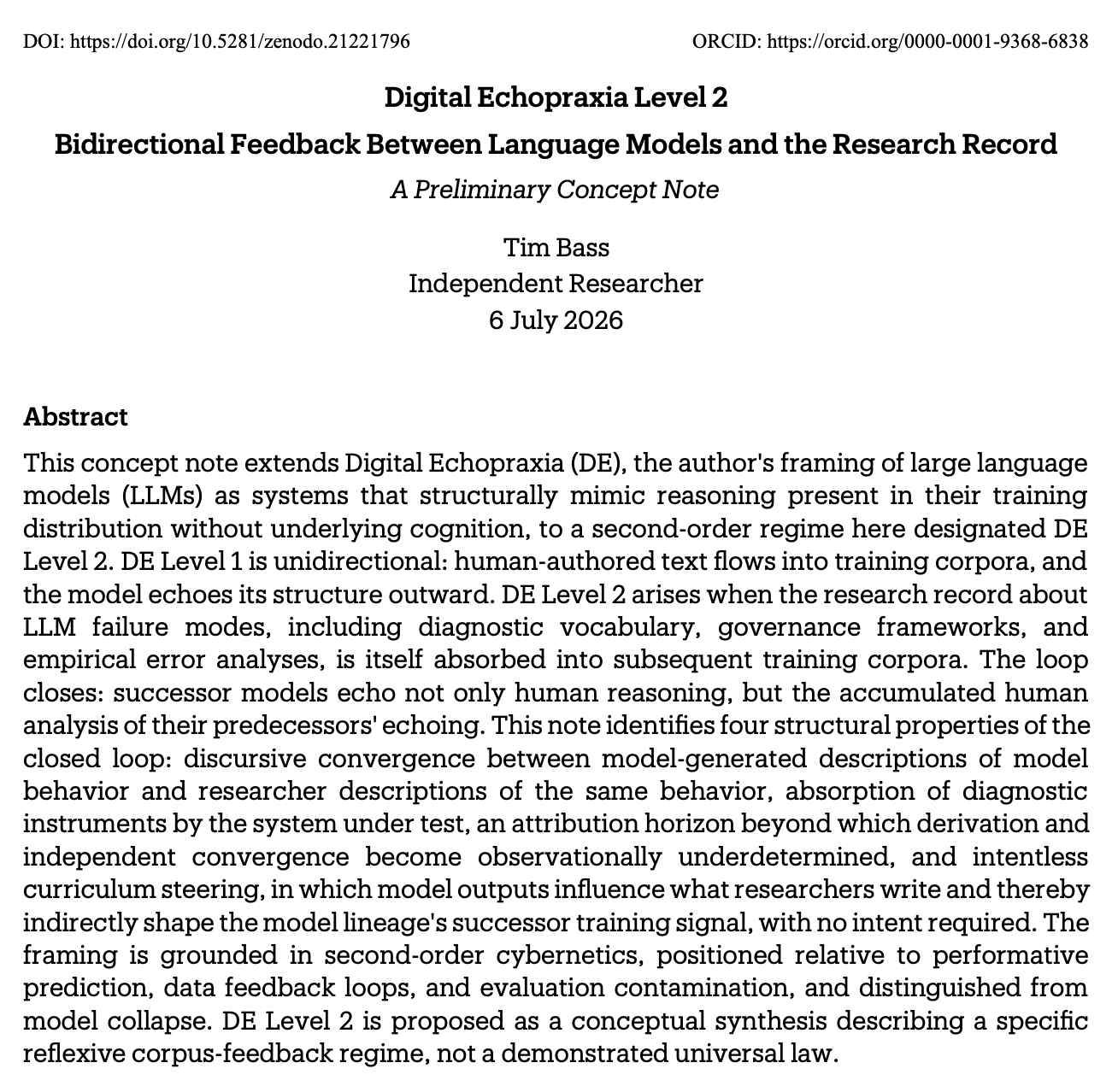
This concept note extends Digital Echopraxia (DE), the author's framing of large language models (LLMs) as systems that structurally mimic reasoning present in their training distribution without underlying cognition, to a second-order regime here designated DE Level 2. DE Level 1 is unidirectional: human-authored text flows into training corpora, and the model echoes its structure outward. DE Level 2 arises when the research record about LLM failure modes, including diagnostic vocabulary, governance frameworks, and empirical error analyses, is itself absorbed into subsequent training corpora. The loop closes: successor models echo not only human reasoning, but the accumulated human analysis of their predecessors' echoing. This note identifies four structural properties of the closed loop: discursive convergence between model-generated descriptions of model behavior and researcher descriptions of the same behavior, absorption of diagnostic instruments by the system under test, an attribution horizon beyond which derivation and independent convergence become observationally underdetermined, and intentless curriculum steering, in which model outputs influence what researchers write and thereby indirectly shape the model lineage's successor training signal, with no intent required. The framing is grounded in second-order cybernetics, positioned relative to performative prediction, data feedback loops, and evaluation contamination, and distinguished from model collapse. DE Level 2 is proposed as a conceptual synthesis describing a specific reflexive corpus-feedback regime, not a demonstrated universal law.
Citation
Bass, T. (2026). Digital Echopraxia Level 2: Bidirectional Feedback Between Language Models and the Research Record (A Preliminary Concept Note) (0.1). Zenodo. Digital Echopraxia Level 2: Bidirectional Feedback Between Language Models and the Research Record (A Preliminary Concept Note) | Zenodo